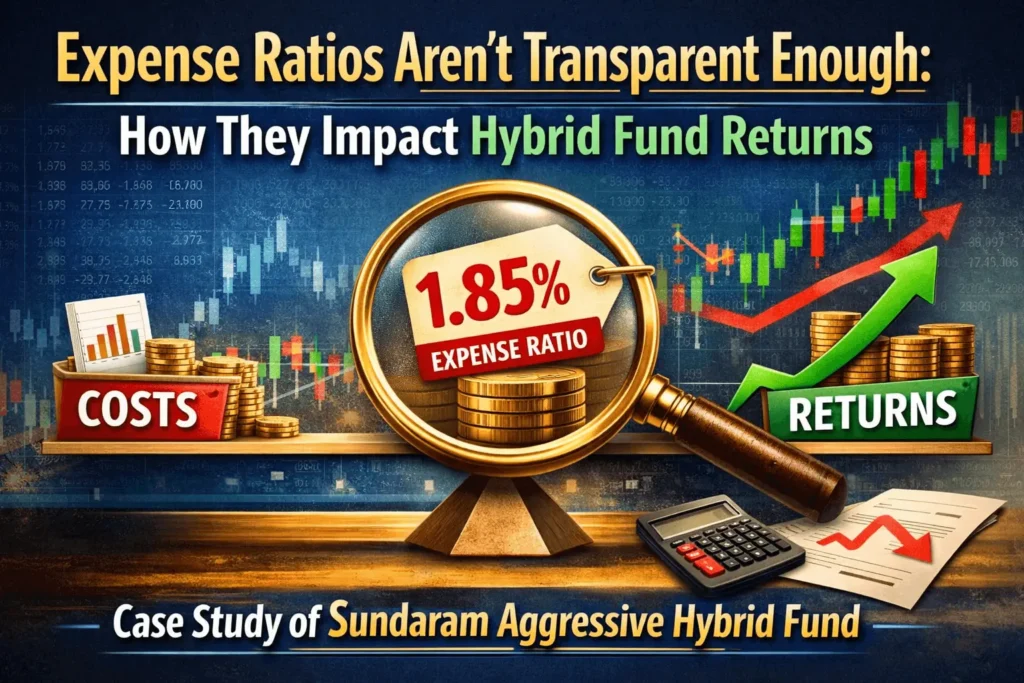
A Case Study of Sundaram Aggressive Hybrid Fund
Investors love hybrid funds for one simple reason: balance.
Equity brings growth. Debt brings stability. Together, they promise smoother rides and fewer sleepless nights. At least, that’s the idea.
But there’s a quiet factor that often escapes attention—expense ratio transparency. It doesn’t make headlines. It doesn’t trend on social media. Yet, it eats into returns every single day.
This article breaks down how expense ratios really impact hybrid fund returns, why investors often underestimate their effect, and what this means in 2026. We’ll use Sundaram Aggressive Hybrid Fund as a practical case study, not to judge the fund, but to understand a problem that affects the entire category.
Let’s get into it.
What Is an Expense Ratio (And Why It Deserves More Attention)?
An expense ratio represents the annual cost charged by a mutual fund to manage your money. It includes fund management fees, administrative expenses, registrar fees, and other operational costs.
Sounds harmless, right?
Here’s the catch:
Expense ratios are deducted daily from the fund’s Net Asset Value (NAV). You never see the deduction. You only see slightly lower returns.
That’s why many investors underestimate its impact.
According to SEBI’s mutual fund regulations, expense ratios are capped and disclosed, but disclosure does not equal clarity. Most investors still don’t understand how these costs compound over time.
Why Hybrid Fund Investors Are Especially Vulnerable
Aggressive hybrid funds invest 65–80% in equity and the rest in debt and money market instruments.
Investors often assume:
- “Hybrid means safer.”
- “Costs won’t matter much here.”
- “Returns are moderate anyway.”
That assumption is risky.
Hybrid funds typically:
- Rebalance portfolios frequently
- Maintain both equity and debt research teams
- Incur higher transaction and management costs
All of this reflects in the expense ratio.
When returns are moderate, every decimal in cost matters more.
Understanding the Structure of Sundaram Aggressive Hybrid Fund
The Sundaram Mutual Fund manages the Sundaram Aggressive Hybrid Fund, a long-standing scheme in India’s hybrid fund space.
The fund:
- Follows SEBI’s aggressive hybrid mandate
- Maintains equity exposure above the 65% threshold
- Uses active management across both equity and debt
This structure offers diversification. It also brings layered costs.
And layered costs demand closer inspection.
The Transparency Gap: What Investors See vs What Actually Happens
Most investors check just one number:
“What’s the expense ratio?”
That’s not enough.
What’s visible:
- Direct plan expense ratio
- Regular plan expense ratio
What’s less visible:
- Portfolio churn costs
- Impact of frequent rebalancing
- Debt-side transaction expenses
- Tracking error due to costs
Expense ratios don’t show opportunity cost. They also don’t show how costs reduce compounding year after year.
This creates a transparency gap.
And gaps create misunderstandings.
Expense Ratio vs Returns: The Compounding Effect Explained Simply
Let’s keep this logical.
If two funds earn the same gross return, but one charges a higher expense ratio, the difference in net returns compounds over time.
Over 1 year, the gap looks small.
Over 10–15 years, it becomes material.
Hybrid funds already aim for risk-adjusted returns, not aggressive alpha. That makes cost efficiency even more critical.
This isn’t theory. It’s basic arithmetic.
Why 2026 Makes This Discussion More Relevant Than Ever
The investing environment in 2026 looks very different from a decade ago.
Key changes:
- Lower expected equity returns
- Tighter debt yields
- Higher investor awareness of costs
- Increased adoption of direct plans
In a lower-return world, expense ratios consume a larger share of gains.
What felt “acceptable” earlier now feels expensive.
This shift forces investors to ask better questions.
Direct vs Regular Plans: The Cost Difference Is Real
One of the most underappreciated facts in mutual fund investing:
Regular plans exist mainly to pay distributor commissions.
That commission comes from—you guessed it—the expense ratio.
Over long periods:
- Regular plans can lag direct plans meaningfully
- The difference compounds quietly
AMFI and SEBI both encourage transparency here, but behavior hasn’t fully changed.
Many investors still choose convenience over cost.
And they pay for it—slowly, invisibly.
Why Expense Ratios Feel “Small” but Hurt “Big”
Human psychology plays tricks on us.
A 1.5% expense ratio sounds tiny.
A 15% return sounds exciting.
But returns fluctuate. Costs don’t.
Expense ratios:
- Apply even in negative years
- Reduce downside protection
- Eat returns before you receive them
Think of it like a leaky bucket. You keep pouring water in, but you never seal the hole.
That’s not dramatic. That’s realistic.
What Sundaram Aggressive Hybrid Fund Teaches Us
This case study isn’t about calling out one fund.
It’s about recognizing that:
- Actively managed hybrid funds carry inherent costs
- Expense ratios must justify value delivered
- Investors should evaluate cost against consistency, not just past returns
A fund can be well-managed and still be cost-inefficient for certain investors.
Both things can be true at the same time.
What Investors Should Actually Evaluate (Beyond Expense Ratio)
Expense ratio alone doesn’t tell the full story. But ignoring it is worse.
Smart investors evaluate:
- Long-term risk-adjusted returns
- Consistency across market cycles
- Expense ratio relative to category peers
- Direct vs regular plan impact
- Portfolio turnover
Cost doesn’t need to be the lowest.
It needs to be worth it.
That’s a crucial distinction.
Regulatory Disclosures Help, But They Don’t Educate
SEBI mandates detailed disclosures. Fund houses comply.
But disclosures:
- Assume financial literacy
- Don’t explain impact clearly
- Often get ignored
Transparency exists on paper.
Clarity is still missing in practice.
That’s the real issue.
The Silent Drag: Why Investors Notice Too Late
Most investors notice cost impact only when:
- Returns disappoint
- A peer fund outperforms
- Long-term goals fall short
By then, years have passed.
Expense ratios don’t trigger alarms.
They whisper.
And whispers compound.
Final Thoughts: Cost Awareness Is Not Optional Anymore
Hybrid funds still make sense for many investors.
But blind trust doesn’t.
As we move deeper into 2026, cost efficiency becomes a core return driver, not a side detail. Expense ratios deserve the same attention as asset allocation and past performance.
The lesson from Sundaram Aggressive Hybrid Fund isn’t negative or positive.
It’s practical.
Understand what you pay.
Understand what you get.
And never assume costs are too small to matter.
Because in investing, the smallest numbers often make the biggest difference.